Energy Isn’t “Woo-Woo”—It’s Your Life Force
 Liz Kaisinger
Still tired after a full night’s sleep? Learn why burnout isn't just physical and how to reclaim your life force across all 4 dimensions of energy.
Energy Isn’t “Woo-Woo”—It’s Your Life Force
Why You’re Still Tired (Even When You Sleep)
A quick note before we dive in: This post was originally “due” according to my schedule two weeks ago, right before I went on vacation. In the past, I would have forced myself to push through and publish it to stay on track.
Instead, I chose to practice what I preach: I gave myself permission to pause. Not just to "take time off" while my brain stayed on the clock, but to step into genuine quiet for two weeks—to disconnect, unpack the mental load, and just be.
I’m back today, unpacked, settled, and posting with a full battery. It feels deeply fitting, because this post is all about giving yourself that exact grace.
Now we'll dive in...
If you’re part of the "sandwich generation"—caring for aging parents while navigating a career and perhaps raising your own children—you know a specific kind of exhaustion.
Or perhaps you’re a high-achiever in a demanding field, the person everyone else "leans on" to get things done.
Maybe you’re the glue in your friend group or the one who keeps the peace in a complicated family dynamic.
Whatever your role, you know the feeling.
It’s the kind of tired that a Saturday morning sleep-in doesn’t fix.
It’s the kind that feels like you’re wading through wet cement before the day has even begun.
You wake up, look at your phone, and before your feet even hit the floor, you feel the weight of the "trees"—the endless, looming logistics of a life that feels like it’s being lived for everyone but you.
In my last post, I talked about the "When, Then" trap—the habit of waiting for life to "calm down" before we give ourselves permission to breathe. But lately, in my conversations with clients and friends, I’ve noticed a deeper, more insidious layer to this trap.
The Myth of the "Perfectly Polished" Life
We don’t just wait for life to get easy; we wait for our approach to life to be perfectly polished.
We tell ourselves that we’ll start that new walking habit, or that meditation practice, or that creative project when we have the "perfect" plan. We let the logistics—the "how," the "where," and the "what if"—become the very trees that block our view of the forest.
I see so many people stop and start their journey toward wellness because they are essentially "punishing" themselves for not being able to create a flawless, Instagram-worthy routine. If they miss one day of yoga, they scrap the whole week. If they eat a meal for convenience rather than "nourishment," they decide they’ve failed and might as well give up.
We’ve been programmed to believe that if we can’t do it perfectly, we shouldn't do it at all. This is the "if only" programming. If only I had more time. If only I were more disciplined. If only I didn't have so many responsibilities.
But here is the truth: This isn't about being "wrong" or "failing." It’s a growth and learning process. It’s about loving where you are right now, exactly as you are—messy house, unfinished to-do list, and all—and choosing to experiment, grow, evolve, and even play.
The Rebellion Against Our Own Care
Have you ever noticed that when you finally set a boundary or decide to do something for yourself—like going for a walk or turning off your phone an hour early—there is a part of you that wants to rebel against it?
We often view these acts of care as another "to-do" on an already overflowing list. We see them as chores. And because we are already so over-extended, we rebel against the very things that would actually nourish us. We treat self-care like a strict parent we’re trying to sneak away from.
But what if we reframed that? What if committing to a small, sustainable, consistent act—even when you don’t "feel" like it—wasn't a chore, but an act of unconditional love?
When you care for a child, a parent, or even a high-priority project at work, you do what is necessary because you are committed to the outcome, regardless of whether you’re "in the mood" to do it. You are giving yourself that same grace. You are saying, "I love myself enough to tend to my foundation, even when the logistics feel like a mountain."
We get caught in the mental energy of "lack" because we’ve been programmed for the "if only" scenario. We think we need a perfect environment to thrive. But the forest is made of both sunlight and shadows, both sturdy oaks and both sturdy oaks and decaying leaves. It is all part of the ecosystem. Your life is the same. It doesn't need to be pristine to be meaningful, and it doesn't need to be "fixed" to be worthy of care.
You Are Not a Single Battery
To understand how to move through the "wet cement" feeling, we have to stop looking at ourselves as machines with a single battery. You are a multidimensional human being. Your health isn't just a physical metric; it is an energetic one.
When I talk about energy, I’m not talking about anything "woo-woo" or abstract. I’m talking about your life force—the actual, tangible fuel you need to handle your day. When we make mistakes, when we are imperfect, or when we feel drained, we often make those things mean something about our character. We create limiting beliefs: "I'm just not a disciplined person," or "I'm destined to be overwhelmed."
These beliefs tie us into a vicious cycle where we can’t see the forest through the trees. To break the cycle, we have to look at the four dimensions of our energy:
1. Physical Energy: The Foundation
This is the most obvious dimension. It’s your sleep, your movement, and the nourishment you give your body. But it’s also about how you feel in your skin. When your physical energy is low, your foundation is shaky. You might find yourself reaching for sugar or caffeine just to make it through a 3:00 PM meeting, or feeling a literal heaviness in your limbs. This isn't a character flaw; it's a structural signal.
2. Mental Energy: The Clarity
This is your focus. When you are overwhelmed by "daily fires"—the logistics of who is picking up the kids, the passive-aggressive email from a colleague, the insurance forms for your parents, or the mounting deadlines at work—your mental energy is consumed by "static." You aren't just tired; you are over-stimulated. Your brain stays in survival mode, which makes it impossible to think creatively or see the big picture. You are so busy looking at the bark of one tree that you’ve forgotten you’re in a forest.
3. Emotional Energy: The Weight
This is the energy of your relationships and the roles you play. Whether you are a counselor holding space for trauma, a manager navigating office politics, or a daughter watching a parent decline, you are constantly holding space for everyone else’s "heavy." If you don't have a way to clear that out, it sits in your body like lead. You might find yourself feeling resentful or "snappy" over small things because your emotional cup is full of other people's water.
4. Spiritual Energy: The Connection
This has nothing to do with religion (unless that is your personal path). This is your connection to yourself, your joy, and your purpose. It’s the "why" that keeps you going. When you lose this, you feel untethered and lost in the fog. You might be "doing all the right things" on paper—working the job, paying the bills, showing up for the family—but you feel like a ghost in your own life. Spiritual energy is the spark that makes the other three dimensions feel worth tending to.
Why Your "Self-Care" Isn't Working
The reason "standard" self-care often fails us is that we try to fix a spiritual or emotional leak with a physical solution.
You cannot "nap" away the emotional exhaustion of watching a parent’s health decline. You cannot "green juice" your way out of a mental burnout caused by a high-stress corporate environment where you feel undervalued. You cannot "retail therapy" your way back to a spiritual connection with your own purpose.
Because these dimensions are all made of energy, they are inextricably linked. They affect one another in a constant feedback loop:
- If you are mentally exhausted from navigating the logistics of a complex project at work, your physical body will feel heavy and slow, as if you’ve run a marathon you never signed up for.
- If you are emotionally drained by a relationship where you are doing all the "heavy lifting," your spiritual connection to your own joy slips away, leaving you feeling cynical or numb.
When we don't understand this, we start to blame ourselves. We think, "I should be able to handle this. I had eight hours of sleep!" But you aren't factoring in the fact that your emotional battery has been at 2% for three years.
Seeing the Forest Through the Logistics
When we are in the thick of it, we react to the "trees"—the individual stressors of the day.
- The tree is the car that won't start.
- The tree is the misunderstanding with your partner.
- The tree is the guilt you feel for not visiting your parents today.
- The tree is the "flaw" in your routine that makes you want to quit everything.
We get so busy fighting the trees that we forget we are standing in a forest. My goal is to help you step back.
When you step back, you realize that the "logistics" aren't the enemy. They are just the terrain. The real work is learning how to navigate that terrain without draining your life force to zero. This is where we stop punishing ourselves for being human. We stop seeing our need for rest as a "failure of discipline" and start seeing it as a necessary calibration of our energy. We move away from the "Hunter" mindset—constantly chasing down problems and hunting for more time—and move toward the Lighthouse mindset.
A lighthouse doesn't run all over the beach trying to save every ship. It doesn't exhaust itself by trying to make the ocean calm. It simply stays grounded, stays steady, and keeps its light on. To do that, it needs a consistent source of fuel. It needs its foundation to be tended to.
An Invitation to Experiment (Not a To-Do List)
Over the next month, I’m going to be sharing more about how we can map these energies out. We are going to look at where your energy is leaking and where it is being nourished. We’re going to look at how to build that "Lighthouse" life, one small, sustainable act at a time.
But for today, I am giving you a radical assignment: Do not add a single thing to your to-do list.
I don’t want you to "fix" your energy. I don’t want you to start a new regime. I just want you to notice.
As you move through your world—whether you are at the grocery store, sitting in a high-stakes board meeting, navigating a difficult conversation with a sibling, or helping a parent with their medication—I want you to pause and ask yourself one question:
“Is my energy feeling light or heavy right now?”
Don't judge the answer. Don't try to change it. Just name it.
- "I'm talking to my boss, and my chest feels heavy."
- "I'm sitting in the garden for five minutes, and my energy feels a little lighter."
- "I'm looking at my to-do list, and I feel like I'm wading through wet cement."
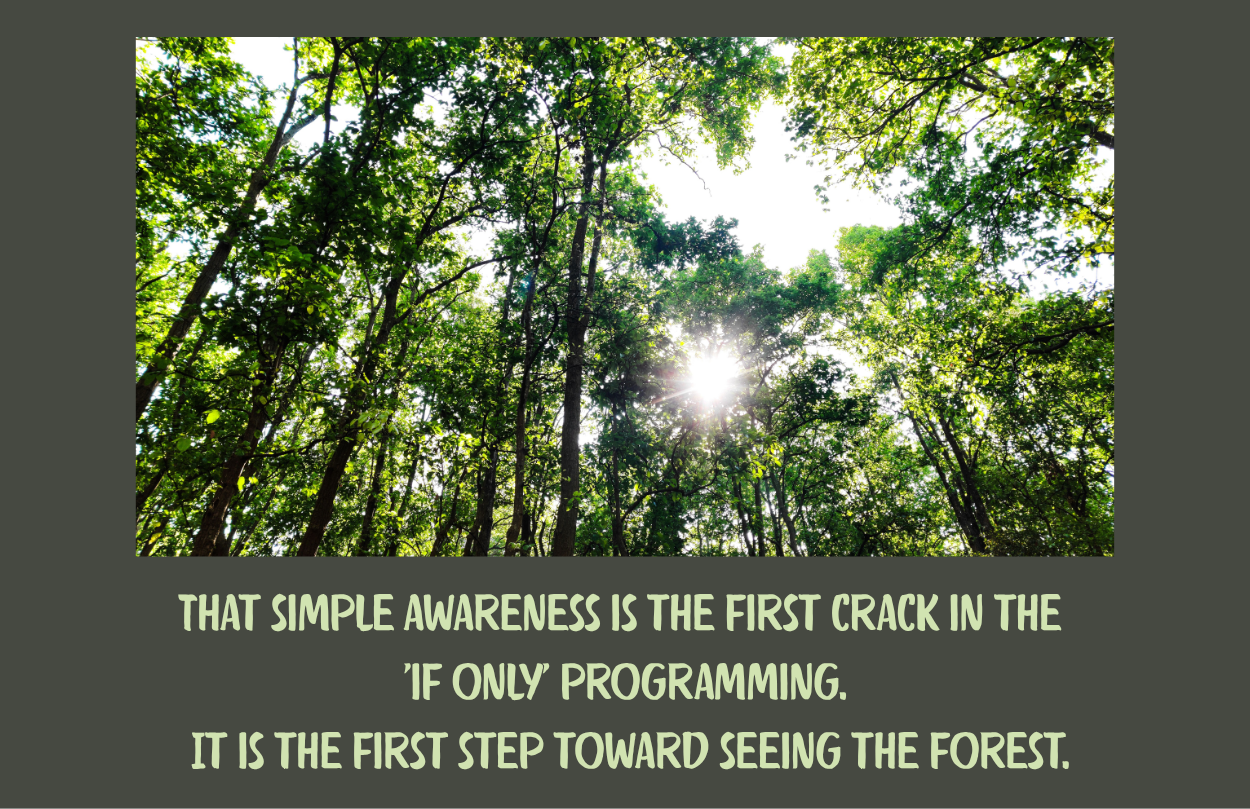
That simple awareness is the first crack in the "if only" programming. It is the first step toward seeing the forest. You aren't just a worker, a daughter, a partner, or a caregiver. You are a whole, multidimensional person, and your light deserves to be tended to—not because you’ve earned it by being perfect, but because you are here.
With permission to be human,
Liz
Want to learn more, just click here to join my mailing list and download your free guided body scan meditation and energy reset.
